You want to move from lane 1 to lane 2 on a two-lane road. A two-wheeled vehicle (A) is approaching fast from behind in lane 2. Which TWO are correct? Select TWO
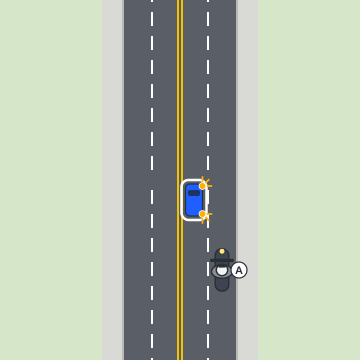
- Your car (blue) is in lane 1 with its right turn signal on
- Two-wheeled vehicle (A) is approaching fast from behind in lane 2
You must not change lanes if it may obstruct a vehicle coming from the direction you want to move into (Article 19(3) of the Road Traffic Act). A turn signal only informs others and gives you no priority, and a small, fast two-wheeled vehicle easily hides in your mirror's blind spot.
Answer: ①, ②
Explanation
You must not change lanes if it could disrupt the normal travel of a vehicle coming in that lane (Road Traffic Act Article 19(3)). Two-wheeled vehicles are small and fast and easily hide in mirror blind spots, so turn your head to check, and change lanes with your turn signal on (Article 38(1)) only after A has passed. Turning on your turn signal and immediately swerving, or ignoring the two-wheeled vehicle, leads to collisions.
Legal basis: 도로교통법 제19조 제3항, 제38조 제1항