At a T-intersection with no traffic lights, you are on the main road and want to turn right into the side road. Car A is stopped right next to the corner at the side-road entrance, and car B is coming out of the side road toward the intersection. Which TWO statements are correct? Select TWO
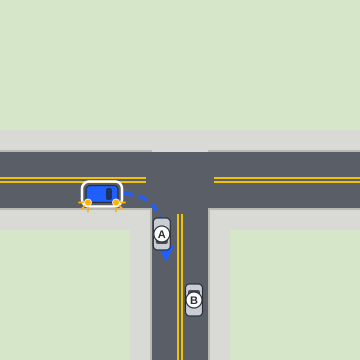
- Your car (blue) is on the main road, about to turn right into the side road
- Car A is stopped right next to the corner, in the lane you will enter
- Car B is coming out of the side road toward the intersection
Article 32 of the Road Traffic Act sets a no-stopping/no-parking distance (5 or 10 meters) for each place, such as the edge of an intersection or a road corner, so be precise about which one applies to a corner. Even when an obstacle forces you to the left of the centerline, you must first check oncoming traffic (Article 13(4)).
Answer: ②, ⑤
Explanation
No vehicle may stop, even briefly, within 5 metres of the edge of an intersection or the corner of a road, so car A is in a prohibited place (Road Traffic Act Article 32(2)). You must turn right slowly (Article 25(1)), and even when an obstruction forces you to the left of the centerline, you must check oncoming traffic (Article 13(4)). Thinking that car B, which is in its own lane, must make way for you is wrong.
Legal basis: 도로교통법 제32조 제2호, 제25조 제1항, 제13조 제4항