You are driving an ambulance carrying an emergency patient with its flashing lights and siren on. The light in your direction is red, and cars A and B on the left and right roads are approaching on green. Which TWO are correct ways to get through the intersection? Select TWO
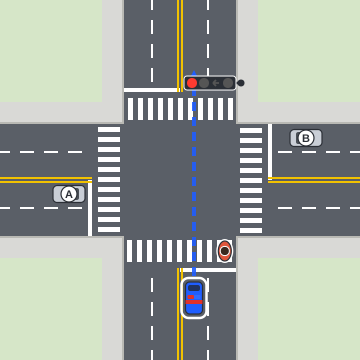
- Your vehicle (blue) is an ambulance carrying an emergency patient, lights and siren on, about to go straight
- Red light in your direction
- One pedestrian is still crossing at the far end of the crosswalk ahead
- Car A on the left road and car B on the right road are approaching the intersection on green
Distinguish what the emergency vehicle exemptions (Articles 29 and 30 of the Road Traffic Act) waive and what they leave in place (Article 29(3)). Flashing lights and a siren only ask others to give way; you must check for yourself whether other vehicles and pedestrians have actually done so.
Answer: ③, ⑤
Explanation
In an urgent and unavoidable case an emergency vehicle need not stop even where the law requires a stop, and the signal-violation rule does not apply to an ambulance (Road Traffic Act Articles 29(2) and 30(4)). Even so, it must travel with particular care for traffic safety (Article 29(3)), so enter slowly after checking that the pedestrian has crossed and that cars A and B, which have a green light, have stopped to give way. Keeping speed on the belief that others will move aside, or assuming you bear no responsibility for a crash, is wrong.
Legal basis: 도로교통법 제29조 제2항·제3항, 제30조 제4호, 제27조 제1항