Intersections are where most crashes and violations happen in Korea, because you have to read the lights, the signs and the order of right of way all at once. Five rules cover most of it. Turn left from the lane next to the center line and pass just inside the center of the intersection; on a plain green light you may turn left only where there is an unprotected left turn sign. Make U-turns only where a U-turn sign allows it, and only under the signal condition shown on the plate below it. At an intersection without signals, give way to a car already in the intersection, then to the wider road, then to the car on your right, and a left-turning car gives way to cars going straight or turning right. Yellow means stop at the stop line, not hurry through, and even on green you must not enter if traffic ahead would leave you stuck inside (no “tail-biting”). Everything below was checked against the Road Traffic Act and its Enforcement Decree and Rules (checked November 2026).
Right turn on red, pedestrians when turning right, and roundabouts are covered in Korean road rules foreigners get wrong.
At a glance
Fines are for a passenger car driver stopped by police (Enforcement Decree Annex 8); points are from Enforcement Rules Annex 28. If a camera catches you, the owner gets an administrative fine instead (Decree Annex 6).
| Situation | What to do | Fine (car) | Points |
|---|---|---|---|
| Signal or sign violation (entering on yellow, U-turn against the condition, etc.) | Go only in the direction and at the time the light or sign allows | KRW 60,000 (camera KRW 70,000) | 15 |
| How to turn left | Slow down along the center line, turn inside the center | KRW 40,000 (intersection passage violation) | — |
| U-turn | Only where allowed, and only without obstructing others | KRW 60,000 (crossing/U-turn/reversing violation) | — |
| Right of way without signals | Car already in → wider road → car on the right → straight before left | KRW 40,000 | — |
| Tail-biting (gridlock) | Do not enter, even on green, if you would stop inside | KRW 40,000 (camera KRW 50,000) | — |
| Turn signal | On from 30 m before the intersection | KRW 30,000 | — |
| Emergency vehicle | Pull clear of the intersection and stop | KRW 60,000 (camera KRW 70,000) | 10 from Feb 24, 2027 |
What each traffic light means
Korean vehicle signals usually have four lamps in a row: red, yellow, green left arrow, green. Red plus the green arrow together means “straight traffic stops, left turns go.” Enforcement Rules Annex 2 defines them as follows.
| Signal | Meaning |
|---|---|
| Green | Go straight or turn right. Left only where there is an unprotected left turn sign (or the 비보호 road marking) |
| Yellow | Stop just before the stop line, crosswalk or intersection. If any part of your car is already in the intersection, clear it quickly. Right turns allowed without obstructing pedestrians |
| Red | Stop before the stop line, crosswalk or intersection. For right turns on red see the road rules guide |
| Green arrow | You may go in the direction of the arrow |
| Yellow / red arrow | Cars going that way must stop (on a yellow arrow, clear the intersection if already in) |
| Flashing yellow | Proceed with caution, watching other traffic and signs (no duty to stop) |
| Flashing red | Stop first before the stop line or crosswalk, then proceed with caution |
The usual yellow mistake: yellow is not extra green. If the light turns yellow before you reach the stop line and you speed up across it, that is a signal violation (KRW 60,000, 15 points). The only exception is when part of your car is already in the intersection; then keep going and clear it rather than stopping inside. If the light has been green for a while as you approach, ease off early so the decision is easy.
Treat flashing red like a stop sign: the wheels must stop before you check left and right and go. Flashing yellow does not require a stop, but it does not give you priority either, so slow down and look around.
Left turns: along the center line, inside the center
Article 25(2) of the Road Traffic Act requires a left-turning car to move along the center line in advance, slow down, and turn using the inside of the intersection’s center. Swinging wide puts you in the path of cars turning left from the other side and of the crosswalk you are turning into. Where the provincial police agency has designated it, you may pass outside the center, so if guide lines for left turns are painted on the road, follow them.
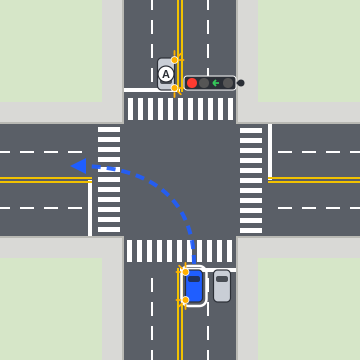
On a left-turn arrow, enter from lane 1 along the center line, turn inside the center and end up in lane 1 of the new road.
- Turn signal: switch it on 30 m before the edge of the intersection (100 m on expressways) and keep it on until the turn is finished (Art. 38(1), Decree Annex 2).
- Two left-turn lanes: use the lane for your vehicle type within the left-turn lanes. Cars and small/medium vans use the left lane (lane 1); large buses, trucks and special vehicles turn from the right lane (lane 2) (Rules Annex 9, note 7). A car may also use the right one (note 2).
- Keep your lane through the turn: if you turn from lane 1, enter lane 1; from lane 2, enter lane 2, so you don’t hit the car next to you.
- Cars behind: when the car ahead is signalling a turn, don’t obstruct it (Art. 25(4)).
Unprotected left turns: on green, oncoming traffic first
You may turn left only on a solid green light, and only at an intersection with an unprotected left turn sign (instruction sign 329) or the 비보호 road marking. The sign itself means “on a go signal you may carefully turn left without obstructing traffic from the opposite direction” (Rules Annex 6). Green gives you no priority: turn only when there is no oncoming straight or right-turning traffic and no pedestrian on the crosswalk you are turning into.
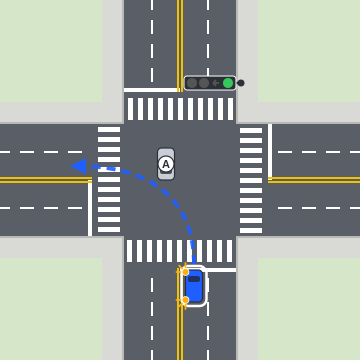
Make the unprotected left turn after oncoming car A has gone through.
- Turning left on red or yellow is a signal violation, sign or no sign.
- At an intersection without the sign, a solid green allows only straight and right. Turning left there is a signal violation.
- If oncoming cars keep coming, wait at the stop line. Don’t be pushed into a gap by a honking car behind you.
U-turns: only where signed, under the stated condition
A green light or green arrow does not by itself allow a U-turn. Make U-turns where one of these is present.
| Marking | Meaning (Rules Annex 6) |
|---|---|
| U-turn sign (instruction sign 311) | Placed on the right or in the middle of the road at the U-turn point |
| Left turn and U-turn sign (309-2) | Left turn or U-turn allowed there |
| U-turn zone line (road marking 502) | A white dashed center line on roads with 3+ lanes each way where U-turns are allowed |
| U-turn arrow (road marking 539) | Painted arrow where U-turns, or left turns and U-turns, are allowed |
Check the plate below the sign. If a signal-condition plate (supplementary sign 407) is attached, you may U-turn only under that signal. “좌회전 시” (when the left arrow is on) means only during the left arrow; “보행신호 시” (when the pedestrian signal is on) means only while pedestrians have green. U-turning at another time is a sign violation (KRW 60,000, 15 points). With no plate there is no particular signal to wait for (the sign does not mean “only on green”), but you may never U-turn if it could obstruct pedestrians or other traffic (Art. 18(1)).
- Signal 30 m ahead for a U-turn too (Art. 38, Decree Annex 2).
- Watch for cars turning right into your road from the right, oncoming straight traffic and pedestrians.
- Crossing a yellow center line to turn where U-turns are not allowed can be treated as crossing the center line (KRW 60,000, 30 points). Never U-turn under a No U-turn sign (regulatory sign 216).
Intersections without signals: who goes first
An intersection with no signals, or with signals switched off, is one “not under traffic control”. You must slow down there, and stop if you can’t see left and right or traffic is heavy (Art. 31). If there is a stop or yield sign, stop or yield as it says (Art. 25(6)). Article 26 sets the order.
| Order | Rule | Article |
|---|---|---|
| ① | Give way to a car already in the intersection | 26(1) |
| ② | If the crossing road is wider than yours, slow down and give way to cars coming from the wider road | 26(2) |
| ③ | If you arrive at the same time, give way to the car on the road to your right | 26(3) |
| ④ | A left-turning car gives way to cars going straight or turning right | 26(4) |
① comes first. The written test also treats “if a left-turning car is already in the intersection, straight traffic gives way to it” as correct. “Already in” means far enough ahead that the other driver can see it and stop, not a reason to rush in to claim priority.
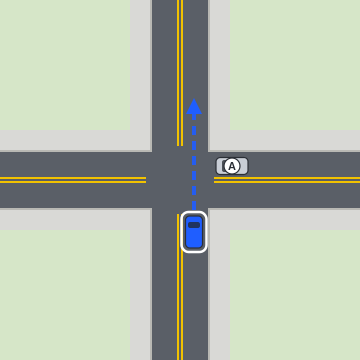
On roads of equal width, arriving together, car A on your right goes first.
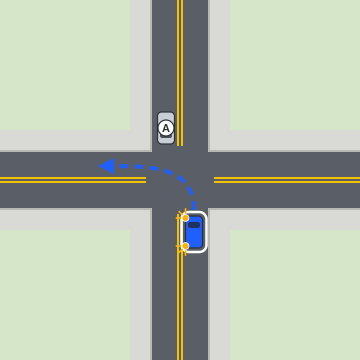
You are turning left and oncoming car A is going straight, so A goes first.
If it’s unclear which road is wider, the safest choice is to stop and watch what the other driver does.
Tail-biting: don’t enter, even on green
At a signalized intersection, if traffic ahead is backed up so that you would stop inside the intersection (past the stop line) and could block other traffic, you must not enter, even on green (Art. 25(5)).
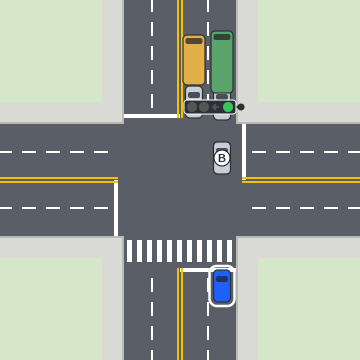
If the road ahead is blocked, wait at the stop line. A car stuck inside like B blocks cross traffic once the light changes.
The penalty is a KRW 40,000 fine for an intersection passage violation, or a KRW 50,000 camera fine. The same applies when the left-turn lane is backed up: a lit arrow doesn’t mean you can follow the car ahead into the middle and stop there.
When an emergency vehicle approaches
When an ambulance, fire engine or other emergency vehicle with lights and siren approaches at or near an intersection, pull clear of the intersection and stop (Art. 29(4)). If you haven’t entered yet, stop before it, keeping to the right; if you are already inside, don’t stop there but drive through and then stop. Away from intersections, give way (Art. 29(5)). The fine is KRW 60,000, and under the August 2026 amendment to Rules Annex 28, 10 points apply from February 24, 2027.
Common mistakes
- Turning left on a solid green out of habit: without the unprotected left sign, it’s a signal violation. Wait for the arrow.
- U-turning because the green arrow is on: U-turn only where signed, under the plate’s condition.
- Speeding up on yellow: stop if you’re before the stop line. Clear the intersection only if you’re already in.
- Swinging wide into lane 2 after a left turn: from lane 1, end in lane 1.
- Rolling through a flashing red: a stop means the wheels stop.
- Assuming the bigger or faster car goes first at an unsignalized junction: order depends on who entered first, road width, the car on the right and direction of travel.
Practice questions
- Which TWO of the following statements about yielding at an intersection without traffic control are correct?
- You are about to enter an intersection without traffic lights, and car A from the road on the left is already passing through it. Which TWO are correct?
- You are driving a passenger car and intend to turn left at an intersection. What is the correct method? (The location has not been specially designated by the Provincial Police Agency Commissioner.)
- You want to turn left at an intersection with a green light. No left-turn arrow is lit and there is no unprotected-left-turn sign. Which TWO statements are correct?
- At an intersection with an unprotected left turn sign, you want to turn left on a green light. Two-wheeled vehicle A is coming straight from the opposite direction, and pedestrians are crossing the crosswalk of the road you will turn into. Which TWO are correct?
- Which TWO of the following statements about flashing vehicle signals are correct?
- At an intersection with a safety sign permitting U-turns, you want to make a U-turn on a green light. Car A is coming straight toward you from the opposite direction. Which TWO are correct?
- The light is green, but the road beyond the intersection is jammed with cars. Which TWO are correct?
- Which TWO of the following statements about emergency vehicles are correct?
For picture questions see how to solve scene questions, and for sign shapes see the safety signs guide. How points add up to a suspension is covered in fines and penalty points.
FAQ
Can I turn left on a green light in Korea?
Only at intersections with an unprotected left turn sign or the 비보호 marking, and even then only without obstructing oncoming traffic and pedestrians. Without the sign, wait for the green left arrow.
What if I can’t stop in time on yellow?
If any part of your car is already in the intersection, clear it quickly. If you’re still before the stop line, the rule is to stop; crossing it is a signal violation. Slowing down early as you approach makes stopping easy.
If a U-turn sign has no conditions, can I turn any time?
With no condition plate, you don’t have to wait for a particular signal. But you may not U-turn if it could obstruct oncoming cars, cars turning in from the right, or pedestrians, so turn only when it’s safe.
Who goes first if two cars reach an unsignalized intersection together?
On roads of equal width, the car coming from the road on the right. If you are turning left and the other car is going straight or turning right, the other car goes first. A car already in the intersection goes before all of these.
Can I just drive through an intersection with a flashing yellow light?
You don’t have to stop, but you must proceed with caution. Traffic facing flashing red must stop before moving off, so slow down on flashing yellow and check the other directions.