Korea drives on the right, and most rules will feel familiar. But a few catch foreign drivers out again and again: right turns on red, stopping for pedestrians at crosswalks, school zones and bus lanes. The most important one: you may turn right on a red light in Korea, but only after coming to a full stop at the stop line, and if there is a separate right-turn signal you must follow it instead. Everything below was checked against the Road Traffic Act and its Enforcement Decree and Rules (checked October 2026). The same rules apply if you drive on an International Driving Permit.
At a glance
Fines (범칙금) are for a passenger-car driver stopped by the police. Penalty points (벌점) count toward a license suspension.
| Rule | Key point | Fine (car) | Points |
|---|---|---|---|
| Right turn on red | Stop at the stop line first, then turn only if you won’t get in anyone’s way. No turn if the right-turn signal is red | — | — |
| Pedestrians at crosswalks | Stop when someone is crossing or about to cross | KRW 60,000 | 10 |
| School zones | Usually 30 km/h, always stop at unsignalized crosswalks, higher fines 08:00–20:00 | up to KRW 150,000 | doubled for some offences |
| Stopped school bus | Flashing lights on: stop first in its lane and the next lane, then pass slowly | KRW 90,000 | 30 |
| Expressway bus lane | 9+ seat vehicles only; cars and vans with 12 seats or fewer need 6 or more people on board | KRW 60,000 | 30 |
| Roundabouts | Counterclockwise; yield to vehicles already circulating | KRW 40,000 (failure to yield) | — |
| Blocking the box | Don’t enter on green if you’ll end up stuck inside the intersection | KRW 40,000 | — |
| Solid white line | No lane changes | KRW 30,000 | 10 |
| Seat belts | Every seat; car seat for children under 6 | KRW 30,000 (driver) | — |
| Phone while driving | No handheld use | KRW 60,000 | 15 |
| Emergency vehicles | Near an intersection: pull clear and stop; elsewhere: give way | KRW 60,000 | 10 from Feb 24, 2027 |
Sources: fines from Annexes 8 and 10 of the Enforcement Decree; points from Annex 28 of the Enforcement Rules. If an unmanned camera catches the offence, the vehicle owner gets an administrative fine (과태료) instead, and the amounts differ (Road Traffic Act Art. 160(3), Enforcement Decree Annex 6) — this matters for rental cars.
Right turn on red in Korea: stop first
Annex 2 of the Enforcement Rules (the meaning of traffic signals) says that on a red light, a vehicle wishing to turn right may do so after stopping just before the stop line, crosswalk or intersection, as long as it does not obstruct other traffic moving on its own signal.
- Come to a complete stop first. Rolling slowly through the turn does not meet this condition.
- Wait for vehicles coming through on their green light — usually traffic crossing from your left.
- At intersections with a dedicated right-turn signal, follow that signal regardless of the other lights. If the right-turn signal is red, you may not turn right (Annex 2, note 3). This has been in force since January 22, 2023.
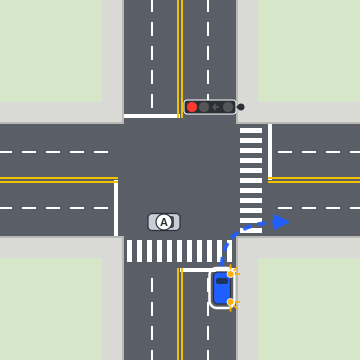
Your light is red and the cross street is green: stop at the stop line and turn only after car A has passed.
Crosswalks: stop even for someone about to cross
Article 27(1) of the Road Traffic Act requires you to stop before a crosswalk (at the stop line if there is one) when a pedestrian is crossing or is about to cross. The words “about to cross” were added from July 12, 2022, so a person waiting at the curb to cross is enough. This applies at crosswalks without traffic lights too.
A right turn takes you across two crosswalks: the one before the intersection and the one on the road you turn into. Even when you turn on green, the crosswalk on the road you’re entering often has a green walk signal, so stop and wait for pedestrians there (Art. 27(2): do not obstruct pedestrians crossing on their signal).
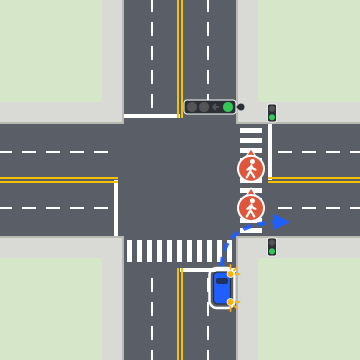
Even on your green light, stop before the crosswalk you’re turning into while people are on it.
The penalty for obstructing pedestrians at a crosswalk is a KRW 60,000 fine and 10 points. If you injure a pedestrian on a crosswalk, it is one of the accidents for which comprehensive insurance does not shield you from prosecution (Act on Special Cases Concerning the Settlement of Traffic Accidents, Art. 3(2), proviso 6).
School zones (어린이 보호구역)
School zones are set up around kindergartens, elementary schools and similar places. They have “어린이 보호구역” signs with start and end markers, and the road surface is often painted red.
- Speed: Local authorities can limit speed to 30 km/h or less (Art. 12(1)). Follow the posted limit.
- Crosswalks without signals: You must always stop, whether or not anyone is there (Art. 27(7), in force since July 12, 2022).
- Higher fines from 08:00 to 20:00 (Enforcement Decree Art. 93(2), Annex 10). For a car: running a red light or obstructing pedestrians at a crosswalk KRW 120,000; speeding up to 20 km/h over KRW 60,000, 20–40 over KRW 90,000, 40–60 over KRW 120,000, more than 60 over KRW 150,000; illegal parking or stopping KRW 120,000.
- Double points in the same hours for running a red light, speeding more than 20 km/h over and failing to protect pedestrians; speeding more than 80 km/h over is 120 points (Enforcement Rules Annex 28, note 4).
- Accidents: Injuring a child (under 13) by breaking the duty of care in a school zone can be prosecuted regardless of insurance (Act on Special Cases, Art. 3(2), proviso 11). Causing a child’s death carries life imprisonment or at least 3 years; injury carries 1 to 15 years or a fine of KRW 5 million to 30 million (Act on the Aggravated Punishment of Specific Crimes, Art. 5-13).
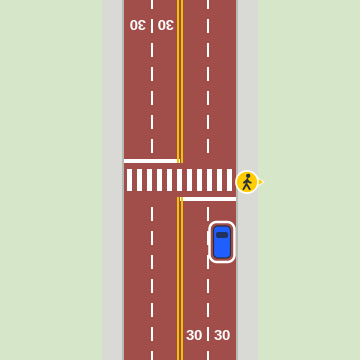
At an unsignalized crosswalk in a school zone, stop at the stop line even if no one seems to be crossing.
The full table of time-based fines, administrative penalties and points, plus Minsik’s Law and timed speed limits, is in School zones in Korea.
When a children’s school bus (usually yellow) is stopped with its flashing lights on to show children are getting on or off, vehicles in the same lane and the lane next to it must stop before reaching the bus, check that it is safe, then pass slowly. On roads with no center line or with one lane each way, oncoming vehicles must do the same. You may not overtake a school bus that is displaying that it is carrying children (Art. 51). This applies everywhere, not only in school zones; the penalty is a KRW 90,000 fine and 30 points.
Default speed limits in Korea
These are the maximum speeds where no sign says otherwise (Enforcement Rules Art. 19(1)). Posted signs always take priority.
| Road | Maximum | Minimum |
|---|---|---|
| Ordinary roads in residential, commercial and industrial areas | 50 km/h (60 km/h on sections designated by the provincial police) | — |
| Other ordinary roads | 60 km/h (80 km/h with 2+ lanes each way) | — |
| Motorways (자동차전용도로) | 90 km/h | 30 km/h |
| Expressway, 1 lane each way | 80 km/h | 50 km/h |
| Expressway, 2+ lanes each way | 100 km/h (80 km/h for trucks over 1.5 t etc.), up to 120 km/h on designated sections | 50 km/h |
The 50 km/h default for urban roads has applied since April 17, 2021. In rain (wet road) or with less than 20 mm of snow, reduce the maximum by 20%; with visibility under 100 m, an icy road or 20 mm of snow or more, reduce it by 50% (Art. 19(2)).
Bus lanes
Expressway bus lanes are only for passenger cars and vans with 9 or more seats, and cars and vans with 12 seats or fewer may use them only with 6 or more people on board (Enforcement Decree Annex 1). So a rented 9-seat van with one or two people in it may not use the lane. The penalty is a KRW 60,000 fine and 30 points.
City bus lanes on ordinary roads are for large buses with 36+ seats, commercial vans and buses with fewer than 36 seats (route buses, etc.), registered children’s school buses and a few others. Private cars may not use them however many people are aboard; taxis may enter briefly only to pick up or drop off passengers (Enforcement Decree Art. 10). The penalty is a KRW 40,000 fine and 10 points.
The sections and hours when bus lanes operate are set by public notice (Enforcement Decree Art. 9(3)), so check the signs and road markings.
Roundabouts: traffic already circulating goes first
Go counterclockwise. When entering, slow down or stop and give way to vehicles already in the roundabout (Art. 25-2). Use your turn signal when entering and leaving (Art. 38(1)).
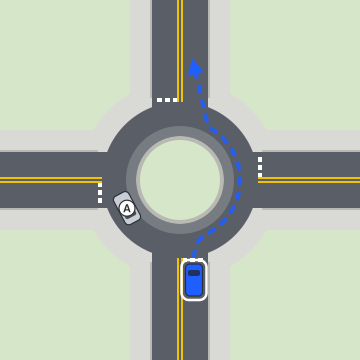
Car A, coming around from your left, goes first. Enter after it passes and go counterclockwise to your exit.
Failing to yield on entry is a KRW 40,000 fine; driving the wrong way (clockwise) is KRW 60,000 and 30 points.
Unprotected left turns (비보호 좌회전)
You may turn left on a green light only at intersections with an “unprotected left turn” (비보호) sign or road marking (Enforcement Rules Annex 2). Turn carefully without obstructing oncoming traffic (Annex 6, unprotected left turn sign), and wait for pedestrians on the crosswalk you’re turning into. Without that sign, a green circular light means straight ahead or right turn only, so you cannot turn left without a green left-arrow. Turning left on red is running a red light.
Don’t block the intersection
Even on a green light, do not enter an intersection if traffic ahead is backed up and you are likely to end up stopped inside it (past the stop line), blocking other vehicles (Art. 25(5)). The penalty is a KRW 40,000 fine for violating intersection rules.
No lane changes across a solid white line
- A solid white line between lanes restricts lane changes; a dashed white line means you may change lanes with care (Enforcement Rules Annex 6, marking 503).
- Solid lines before intersections and crosswalks are lane-change restriction lines; on roads with 2+ lanes each way they can extend up to 50 m from the stop line (Annex 6, marking 506).
- Where one side is solid and the other dashed, you may change lanes only from the dashed side (Annex 6, marking 507).
Changing lanes where it is prohibited (Art. 14(5)) is a KRW 30,000 fine and 10 points, except when road damage or roadworks leave an obstacle. Crossing the yellow center line is more serious: KRW 60,000 and 30 points.
Seat belts and child car seats
- The driver and passengers in every seat must wear a seat belt, on ordinary roads as well as expressways, including the back seats (Art. 50(1)).
- Children under 6 must ride in a safety-certified child restraint (car seat) secured with the seat belt (Art. 50(1), Enforcement Rules Art. 30).
- A driver without a belt is fined KRW 30,000; if a passenger is unbelted, the driver pays an administrative fine of KRW 30,000, or KRW 60,000 if the passenger is under 13 (Enforcement Decree Annex 6).
- Exceptions include injury, illness or pregnancy making a belt unsuitable, and reversing (Enforcement Rules Art. 31).
Using a phone while driving
You may not use a mobile phone while driving (Art. 49(1)10). Exceptions: when the vehicle is stopped, when driving an emergency vehicle, in an emergency such as reporting a crime or disaster, and when using a hands-free device (Enforcement Decree Art. 29). Showing video where the driver can see it, or operating a screen while driving, is also prohibited, although navigation and traffic information may be displayed (Art. 49(1)11 and 11-2). The penalty is a KRW 60,000 fine and 15 points.
Giving way to emergency vehicles
- At or near an intersection, when an ambulance, fire engine or other emergency vehicle approaches, pull clear of the intersection and stop (Art. 29(4)).
- Elsewhere, give way so the emergency vehicle can pass first (Art. 29(5)).
The fine is KRW 60,000. There are no points for this today, but under the amendment to Annex 28 of the Enforcement Rules made on August 24, 2026, 10 points will apply from February 24, 2027.
Practice questions
These rules come up often in the written test. Try practice questions based on the law:
- Turning right on red while cars come through on green from both sides
- Turning right on green with pedestrians on the crosswalk you’re turning into
- Unsignalized crosswalk in a school zone with no one in sight
- Passing a school bus stopped with its flashing lights on
- Who may use the expressway bus lane?
- Entering a roundabout while car A circulates from your left
- Turning left on green at an unprotected left turn sign
- Green light, but traffic is backed up beyond the intersection
For the test format see the written test guide, and practice under time pressure with a mock exam. The road test also checks these rules (road test guide).
FAQ
Can you turn right on red in Korea?
Yes, but only after coming to a full stop just before the stop line or crosswalk, and only if you won’t obstruct traffic coming on a green light or pedestrians on the crosswalk. If there is a right-turn signal and it is red, you may not turn.
What hours are school zones enforced in Korea?
The speed limit and the duty to stop apply at all times. The higher fines and double points apply from 08:00 to 20:00.
Can I use the expressway bus lane in a rented 9-seat van?
Only with 6 or more people on board. Cars and vans with 12 seats or fewer need at least 6 occupants, even if they have 9 or more seats.
Do the same rules apply if I drive on an International Driving Permit?
Yes. Everyone on Korean roads follows the Road Traffic Act. For how long you can drive on an IDP, see International Driving Permit in Korea; to switch to a Korean license, see Exchanging a foreign driver’s license.