The Korean written driving test includes questions where you look at a bird’s-eye diagram (or a photo) of a road and choose the correct way to drive. They look harder than text questions, but if you always scan the picture in the same order, most of them come down to a handful of rules. In short: (1) find your car and what it is trying to do, (2) check what sets the rules — the light, signs and road markings, (3) decide who goes first among pedestrians and other vehicles. The six scenes below are drawn with this site’s own scene diagrams, and every rule was checked against the Road Traffic Act and its Enforcement Decree and Rules (checked November 2026).
KoROAD only says the written test is multiple choice and that 40 questions are drawn from the published question bank. It does not publish how many picture questions there are or how they are scored. Always pick as many answers as the question asks for (for example, “Choose two”). For the test format itself, see the written test guide.
What to look at first: a 6-step scan
Don’t read the answer options first. Scan the picture in this order — it takes about 30 seconds.
| Step | Look at | Ask yourself |
|---|---|---|
| 1 | Your car | Which lane? Turn signal or arrow: going straight, left or right? Before the stop line or already in the intersection? |
| 2 | Traffic light | Is your light green, yellow, red or a left-turn arrow? Is there no light at all? |
| 3 | Signs and markings | Unprotected left turn sign, school zone (red pavement), stop line, solid or dashed centerline? |
| 4 | Space | Is there room for your car where you’re going? Do you need to change lanes? |
| 5 | Pedestrians and bikes | Anyone on the crosswalk or waiting at the curb? A bicycle next to your path? |
| 6 | Other vehicles | Oncoming traffic, cars in the next lane, an emergency vehicle behind you? If the question labels a car A or B, it matters. |
If a police officer directing traffic gives a signal that differs from the traffic light, follow the officer (Road Traffic Act Article 5(2)). And remember that a green light only means you may go: pedestrian protection, the no-blocking rule and yielding to emergency vehicles still apply. That is why so many correct answers are “stop” even on green.
Scene 1. Green light, but you want to turn left
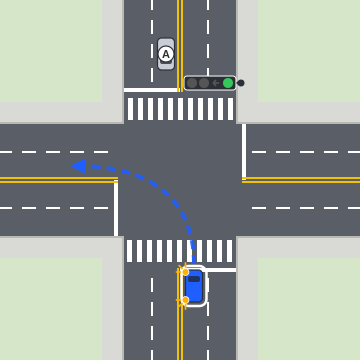
Your light is a green circle — no left arrow, and no unprotected left turn sign.
- Look at: whether the light is a green circle or a green left arrow, and whether there is an unprotected left turn sign anywhere.
- Rule: a green circle allows straight ahead and right turns only. You may turn left on green only where an unprotected left turn sign or road marking is present (Enforcement Rules Annex 2). Otherwise wait for the green arrow.
- Correct action: wait at the stop line. If there were an unprotected left turn sign, you could turn on green, but only carefully and without getting in the way of oncoming car A — let it pass first (Annex 6, sign 329). When turning left, pass inside the center of the intersection (Article 25(2)).
- Common traps: “Turn quickly before the oncoming car” and “Turn left without a sign if the oncoming car is far away” are both wrong.
Scene 2. Green, but the far side is backed up
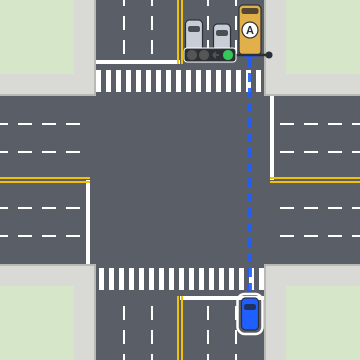
The light is green, but traffic is queued right up to the far crosswalk.
- Look at: before the light, check whether there is room for your car on the far side.
- Rule: at a signalized intersection you must not enter if traffic ahead means you would stop inside the intersection (past the stop line) and block other traffic (Article 25(5)).
- Correct action: stay at the stop line even on green and go only when space opens up.
- Common traps: “Follow the car ahead because the light is green” or “Hurry in before the light changes” — classic answers designed to catch people who only look at the light.
Scene 3. Turning right with a bicycle and a pedestrian
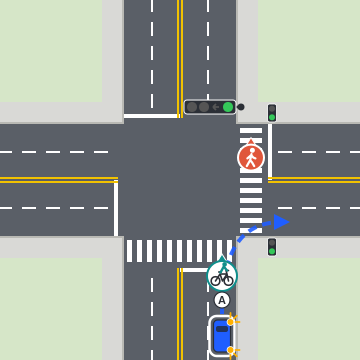
Two hazards: bicycle A ahead of you, and a pedestrian on the crosswalk you’re turning into.
- Look at: in any right-turn question, check the right side of your path (bicycles, motorcycles) and the crosswalk on the road you’re turning into.
- Rule: when turning right, keep to the right edge, drive slowly and watch for pedestrians and bicycles moving with the signal (Article 25(1)). Don’t obstruct pedestrians crossing on their signal (Article 27(2)), and keep enough distance when passing a bicycle going the same way (Article 19(2)).
- Correct action: don’t cut in front of bicycle A — follow slowly behind and let it go first. After turning, make a temporary stop before the crosswalk and wait until the pedestrian has crossed.
- Common traps: “Turn quickly before the bicycle,” “Go through because the pedestrian is at the far end,” “Honk to make the bicycle move.” Repeated or continuous honking that bothers others is prohibited (Article 49(1)8).
This layout is typical of “choose two” questions: two hazards usually mean one correct answer for each.
Scene 4. An ambulance comes up behind you at an intersection
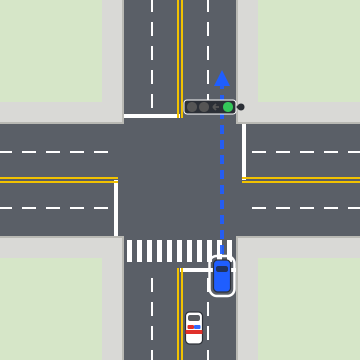
Your light is green, and an ambulance is heading for the intersection behind you.
- Look at: with any emergency vehicle, first check whether you are at or near an intersection. The answer depends on it.
- Rule: at or near an intersection, keep clear of the intersection and make a temporary stop (Article 29(4)). Anywhere else, give way so the emergency vehicle can pass first (Article 29(5)).
- Correct action: as in the picture, if you haven’t entered yet, don’t enter — pull to the right and stop. If you’re already inside, clear the intersection and then stop.
- Common traps: “Stop right in the middle of the intersection” (this blocks the ambulance), “Go straight because it’s green,” “Follow closely behind the ambulance.”
Scene 5. You want to overtake a slow truck
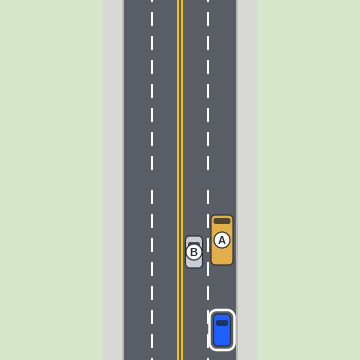
Car B is running alongside truck A on its left.
- Look at: in overtaking questions, check whether the left side of the vehicle ahead is clear, whether it is itself overtaking, whether you’re in an intersection, tunnel or on a bridge, and whether the centerline is solid.
- Rule: overtake on the left of the vehicle ahead (Article 21(1)). You may not overtake when another vehicle is running alongside it on its left, or when it is overtaking or about to overtake someone (Article 22(1)). Intersections, tunnels and bridges are no-overtaking places (Article 22(3)). A solid yellow centerline may not be crossed (Enforcement Rules Annex 6, marking 501).
- Correct action: keep a safe distance behind A. Once B has gone and lane 1 is clear, signal and change lanes.
- Common traps: “Pass on the right” (passing on the right is allowed only for bicycles and similar passing a slow or stopped vehicle, Article 21(2)), “Squeeze between A and B.” If you are the one being overtaken, “Speed up to compete” is wrong (Article 21(4)).
Scene 6. Turning left at an intersection with no lights
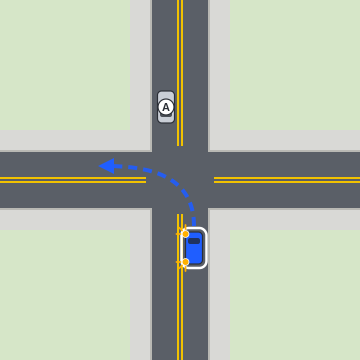
No traffic lights. Car A, opposite you, is going straight.
- Look at: with no lights, check in turn who entered first, which road is wider, whether a car is on the road to your right, and whether you are turning left.
- Rule: at an intersection without traffic control, yield to a vehicle already in it (Article 26(1)); from the narrower road, yield to vehicles coming from the wider road (26(2)); if you arrive at the same time, yield to the vehicle on the road to your right (26(3)). A vehicle turning left yields to vehicles going straight or turning right (26(4)). Drive slowly at such intersections (Article 31(1)), and make a temporary stop if you can’t see left and right or traffic is heavy (31(2)).
- Correct action: slow down, wait before the intersection, and turn after car A has gone through.
- Common traps: “I signaled first, so I go first,” “I’m closer to the intersection, so I turn first.” A turn signal tells others what you’ll do; it does not give you priority.
Other scenes that come up often
You’ll see these again and again. Remember the one-line rule for each.
| Scene | Check first | Rule (source) |
|---|---|---|
| Light turns yellow | Before the stop line, or partly in the intersection already? | Before: stop. Already in: clear the intersection quickly (Enforcement Rules Annex 2) |
| Right turn on red | Stop line, green traffic from the left, right-turn signal | Stop at the stop line first, turn only if you won’t obstruct anyone; no turn if the right-turn signal is red (Annex 2) |
| Crosswalk without lights | Someone waiting at the curb | Temporary stop when someone is crossing or about to cross (Article 27(1)) |
| Pedestrian crossing where there’s no crosswalk | Person on the road | Keep a safe distance and stop (Article 27(5)) |
| School zone | Red pavement, “30”, crosswalk without lights | Stop at unsignalized crosswalks even if nobody is there (Article 27(7)) |
| Stopped school bus | Flashing lights; are you in its lane or the next? | Stop before reaching it, then pass slowly; also oncoming traffic on roads with no centerline or one lane each way (Article 51) |
| Lane change | Car behind in the next lane, solid white line | Don’t change if it would obstruct that car (Article 19(3)); don’t change where it’s prohibited (Article 14(5)) |
| When to signal | Distance to the intersection | From 30 m before on ordinary roads, 100 m on expressways (Enforcement Decree Annex 2) |
School zones, right turns on red and roundabouts are explained with diagrams in Road rules foreigners get wrong.
Tips for “choose two” questions
- Count the hazards first. How many things in the picture affect what you do — pedestrians, bikes, other cars, the light? If there are two, the two correct answers often deal with one each (Scene 3).
- Tell “stop” from “slow down.” The law separates a temporary stop (wheels fully stopped) from driving slowly (slow enough to stop at once). Pedestrians on a crosswalk, unsignalized crosswalks in school zones and emergency vehicles near an intersection all call for a temporary stop.
- Be suspicious of extreme options. “Brake hard,” “keep honking,” “speed up and go first,” “cross the centerline to avoid it” are almost always wrong. Sudden braking is banned except to avoid danger (Article 19(4)), and so is repeated honking (Article 49(1)8).
- Don’t imagine things that aren’t in the picture. Decide only from what is drawn.
- The two answers never contradict each other. “Stop immediately” and “speed up to get through” can’t both be right. Once you’ve picked one, cross out anything that conflicts with it.
- Check whether the question asks for the wrong one. Re-read the end of the question before you answer.
Checklist before the test
| ✓ | Item |
|---|---|
| ☐ | Scan: your car → light → signs and markings → space → pedestrians → other vehicles |
| ☐ | Green circle = straight and right; left only on an arrow or with an unprotected left turn sign |
| ☐ | Don’t enter on green if there’s no room on the far side |
| ☐ | Right turn: check both the bike on your right and the crosswalk you’re turning into |
| ☐ | Emergency vehicle: near an intersection, keep clear and stop; elsewhere, give way |
| ☐ | Overtake only on the left; never with a car alongside it, or in an intersection, tunnel or on a bridge |
| ☐ | No lights: a left-turning car yields to cars going straight or turning right |
| ☐ | Re-check how many answers to pick and whether it asks for correct or incorrect |
This site’s practice questions include scene diagrams drawn the same way, with explanations in English, Korean, Chinese and Vietnamese. To practice under real time limits, try the mock exam. For distances like 30 m and 100 m, see the numbers cheat sheet; for more on intersections, see Intersection rules.
FAQ
How many picture questions are on the test, and how many points are they worth?
KoROAD does not publish the number or scoring by question type. The 40 questions are drawn at random from the public question bank, so the number of picture questions can vary.
Is the blue car always my car?
In this site’s diagrams, the blue car with a white outline is yours. Real test pictures may mark it differently, so check which car the question calls “your car.”
The question has two answers but I’m sure of only one. What now?
Pick the one you’re sure of, cross out options that contradict it or are extreme (hard braking, honking, speeding up, crossing the centerline), then choose the option that deals with the other hazard in the picture.
Why is “stop” the right answer when the light is green?
Green means you may proceed, not that you must. If the picture shows a pedestrian on the crosswalk, a backed-up far side or an approaching emergency vehicle, those rules apply too.
Can’t I just memorize the real test questions?
Looking at the public bank helps, but in picture questions a small change in a car’s position or the light changes the answer. If you learn the scan order and the rules behind it, you can solve pictures you have never seen before.